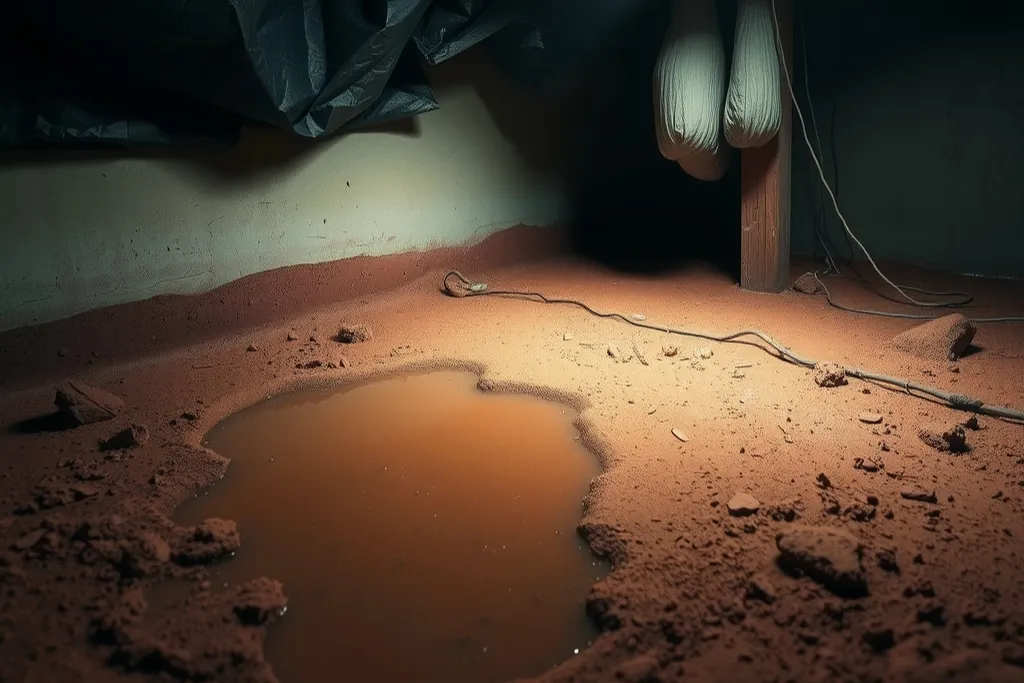
Why do Atlanta crawl spaces stay wet long after the rain?
Red clay is the reason. Piedmont clay soil in much of the metro drains slowly, so water pushed against a foundation by a sloping lot has nowhere to go and sits. Then humid subtropical summer air comes in through the vents and keeps the space damp on its own.
The terrain compounds it. Hilly ground around the city means most lots fall towards a street or a creek, and a crawl space on the low side of a house can be taking the runoff of an entire yard. Around 49.7 inches of rain a year arrives here spread across all twelve months, so there is rarely a long dry spell to let the soil recover.
Then there is the season nobody plans for. In July and August the outside air is so humid that opening the foundation vents brings moisture in rather than letting it out, which is why a crawl space can read wetter in August than it did in April with no leak anywhere. Managing that is about the ground cover, the air and the ductwork, not about pumping.
What is worth knowing when you call is whether the water is new or recurring. A one-off is a restoration job. A space that fills every spring is telling you about gutters, downspout discharge, grading or a footing drain, and the lasting repair is outside the house rather than under it.
Is standing water under the house actually urgent?
Yes, because the structure is in it. Floor joists, band joists and subfloor plywood absorb water from below, and in Atlanta's warm months wet wood can start growing mold within a few days. The longer it sits, the more of the floor system is involved.
Wood does not have to be submerged to be in trouble. Joists eighteen inches above standing water sit in near-saturated air, and the moisture content climbs steadily until fasteners corrode, subfloor layers separate and the floor above starts to feel different underfoot. That is why the standing water comes out before anything else is decided.
There is also the air path to think about. Houses move air upwards, so what is under the floor largely ends up in the rooms above, and a damp crawl space becomes an indoor air problem rather than a basement problem. Mold can trigger allergy and asthma symptoms in some people, which is reason enough not to leave it for a month.
Where the source was a drain line, the urgency changes character. Contaminated water under a house is a health hazard and not a cleaning job: it is contained, the crew works in protective equipment, porous material comes out, and the soil itself is treated. That is handled the same way as a sewage backup cleanup indoors.
What does a damp crawl space do to the rooms above?
It moves in with you. Air travels upwards through a house, so crawl space humidity, odor and whatever is growing on the joists end up in the living space. The usual signs are a musty smell on humid days, cupping floors and registers that smell damp when the air handler runs.
Hardwood is the visible evidence. A floor over a wet crawl space takes up moisture from its underside faster than from the room, the boards swell at the bottom edge and cup upwards, and that happens evenly across a whole room rather than in the one spot a spill would make. Catching it early usually means the boards flatten back out as the readings come down.
Ductwork under the floor adds its own loop. Cool supply ducts sweat in a humid crawl space, insulation on them gets wet, and in some houses the return side draws crawl space air into the system directly. Checking the duct insulation and the register smells is part of reading how long the space has been damp.
The useful test is a number, not a nose. Moisture content readings on the joists and subfloor plus relative humidity in the space tell you whether this is a current problem or an old stain, and the same readings are what prove the space is dry at the end. Mold inspection and moisture mapping is the service to ask for when you want that in writing before deciding anything.
- Moisture content read on joists, band joists and the subfloor underside
- Relative humidity and temperature logged in the space itself
- Duct and pipe insulation checked for condensation and wet wrap
- Ground cover condition and coverage noted before anything is lifted
What happens to the vapor barrier and the insulation?
Saturated batt insulation is removed and replaced, because it loses its value and holds water against the joists. A torn, undersized or soil-covered vapor barrier comes out as well, and new ground cover goes down only once the clay underneath is no longer wet.
A vapor barrier is a sheet of polyethylene over the soil, and its job is to stop ground moisture evaporating up into the space. Many older Atlanta crawl spaces have a partial one, a shredded one or none at all, and plenty have one with water ponded on top of it, which is the worst case because the water cannot drain and cannot evaporate either.
Order matters when it is replaced. Laying new plastic over wet clay seals moisture in and gives a false sense that the problem is solved, so the soil is dried and the readings checked before the cover goes down. Overlaps, edges up the piers and the perimeter are what make the difference between a barrier and a tarp.
Insulation is the other judgment call. Batts between joists that have been soaked sag, trap water against the wood and never recover their rating, so they come out. Replacing them, and deciding whether to keep the space vented or manage it with a dedicated dehumidifier, is a separate conversation after drying rather than part of the emergency.