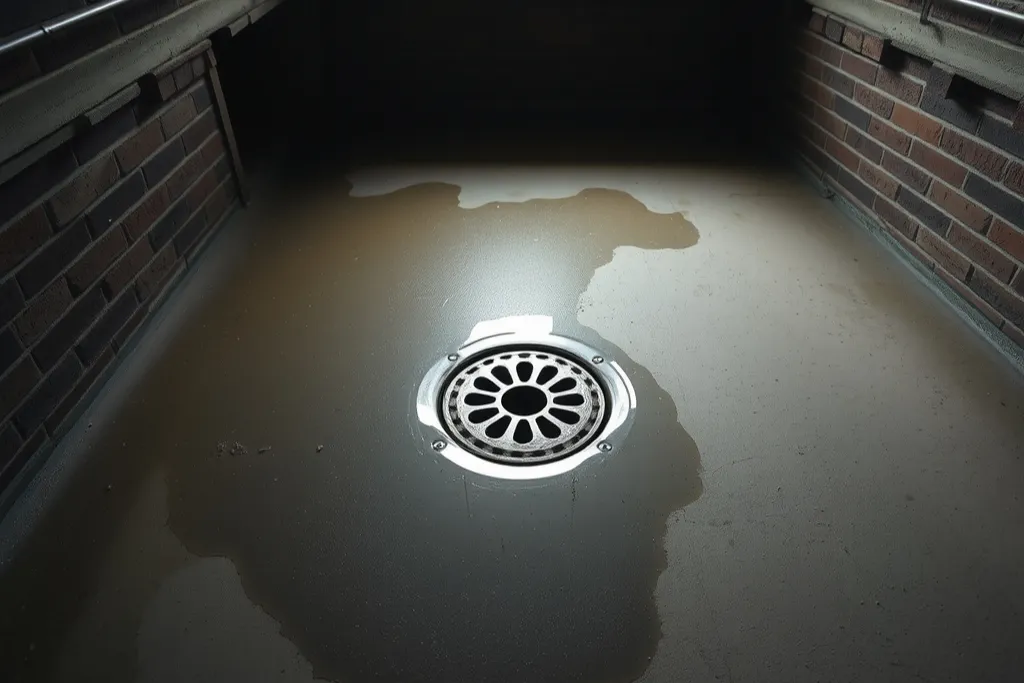
Why does sewage back up into older Atlanta houses in heavy rain?
Because some of the older city carries stormwater and sewage in one pipe. A long downpour fills that pipe faster than it empties, and the water then rises through the lowest opening connected to it, which is usually a basement floor drain, a ground-floor shower or a laundry standpipe.
The history is documented. A 1998 federal consent decree, with a companion decree in 1999, put the city's sewer system under federal oversight. Seven combined sewer overflow control facilities were built in the mid-1980s and early 1990s, and by 2000 the EPA recorded that controls had cut overflow volume by about 60 percent and solids loading by about 75 percent. The system is far better than it was, and heavy rain can still overwhelm parts of it.
Geography does the rest. Both Intrenchment Creek, the South River's largest urban tributary, and Proctor Creek begin downtown, where paving keeps rain from soaking in, so runoff heads straight into pipes and then into neighborhoods downstream. Roughly 2,600 acres of Southeast Atlanta drain through Upper Intrenchment Creek and the Beltline into the combined system, and the Intrenchment Creek overflow facility on Custer Avenue SE, built with the East Area system in the mid-1980s, is limited by a 1997 consent decree in how much combined sewage it may discharge.
In the Proctor Creek watershed, Vine City and English Avenue went through decades of street and house flooding that overwhelmed aging sewers and in some cases pushed raw sewage into houses; the city has since built green infrastructure along Boone Boulevard, including the Cook Park flood-control park and its retention ponds. The honest way to read all of this: some older neighborhoods have combined or aging sewers, and whether a given address is on one is a question for the utility. The Atlanta sewer backup guide goes through it street by watershed.
What has to be thrown out after a sewage backup, and what can be saved?
Porous material that sewage touched is removed, not dried. Carpet and pad, soaked insulation, wet drywall, particleboard cabinet bases, mattresses and upholstered furniture leave the building. Sealed hard surfaces such as concrete, tile, glass, metal and solid wood trim can be cleaned, disinfected and kept.
The rule behind that list is simple: if a material holds water in tiny spaces you cannot physically scrub, you cannot prove it is clean. Carpet pad is a sponge. The paper face and gypsum core of drywall wick water up the wall well above the visible line. Particleboard and medium-density fiberboard swell and never recover, which is why the toe kick and base of a kitchen or laundry cabinet run usually comes out even when the box above looks untouched.
Soft and absorbent household items in the water go the same way, and that is the part homeowners find hardest. Food, including sealed cans that sat in it, paper, cardboard, books, children's soft toys and pillows are discarded. Hard-surfaced toys, dishes, tools, metal shelving and solid-wood furniture can often be cleaned, and contents cleaning is priced separately. Take photographs of everything before it is moved or bagged so you have your own record.
Solid hardwood flooring is the judgment call. Where sewage has run between boards and into the subfloor, the flooring usually comes up so the sheathing underneath can be cleaned and dried or replaced. That decision is made with meter readings and with you, not quietly on the invoice.
What should I not do while I wait for a crew?
Do not run a wet vacuum, shop vac or carpet cleaner through sewage: it aerosolizes contaminated water through the house and ruins the machine. Do not mop with household bleach and call the room clean, do not run the heating or cooling on that level, and keep everyone out.
Bleach has two problems here. It is deactivated by the organic soil that sewage is full of, so it spends itself on the mess rather than on anything living in it, and it cannot reach into porous materials where the contamination actually sits. A wiped floor over a soaked carpet pad looks finished and is not. Mixing bleach with other household cleaners, particularly anything containing ammonia, also produces gases you do not want in a closed lower level.
The second instinct to resist is drying first. Fans blowing across contaminated material move whatever is on it into the air and into the rest of the house, which is exactly why the heating and cooling system stays off until the area is clean. Removal and cleaning come first and structural drying comes second, and shoes that walked through it get bagged rather than carried upstairs.
Does homeowners insurance cover a sewer backup in Georgia?
Usually not without an endorsement. A standard Georgia homeowners policy generally covers sudden, accidental water damage from inside the house, and commonly excludes flood and sewer or drain backup unless backup coverage was added. Read your own policy wording and ask your agent before you assume anything.
Georgia's Insurance Commissioner has put it bluntly in press interviews: a home policy basically covers wind and fire, and flood is not on the list. Flood insurance is a separate policy, federally backed through the National Flood Insurance Program or written privately, and bought through an agent. Backup of sewers and drains is its own endorsement again, with its own limit. Long-term seepage is commonly excluded on top of all that.
What the crew can do is document. Photographs, a written scope, the list of discarded items and daily moisture readings all go to you, and you can hand them to your insurer. What nobody on a phone line can do is tell you what will be paid. The Georgia Office of Commissioner of Insurance and Safety Fire runs a Consumer Services Division on 404-656-2070 or 1-800-656-2298 and publishes at gainsurance.org, and the Georgia water damage insurance guide explains how these policies are usually written.
Who do I report a sewer overflow to around Atlanta?
Inside the city, water, sewer and stormwater are run by the City of Atlanta Department of Watershed Management. DeKalb addresses go to the DeKalb County Department of Watershed Management, and Cobb, Clayton and Douglas each run their own utility, so confirm which one serves your address before you call.
Reporting is not a formality. It puts the overflow on the record, it can get a blocked main cleared, and it establishes whether the water came from the public system or from your own lateral, which matters to every conversation that follows. Spills in this metro are logged and reported: a rain-driven spill sent sewage into Utoy Creek in December 2018, a lift-station spill at the airport released roughly 30,000 gallons into Sullivan Creek near College Park, and a wastewater overflow reached Queen Creek in Mableton in October 2023.
Cleanup does not have to wait for the utility, and in a contaminated lower level it should not. Removal, cleaning and drying can start while the cause is still being chased, as long as water use in the house stops and the source is not still flowing into the room.